If your latest Victorian council rates notice is significantly higher than last year, you may be wondering what caused the increase and whether you can challenge it.
Property owners across Victoria have recently raised concerns about sharp increases in their council rates, including homeowners who say the increase does not appear to reflect current property market conditions.
There isn’t always one reason for a higher bill. Your rates notice can be affected by changes in your property’s valuation, council rating calculations and other charges collected through the notice. Recent changes to Victoria’s Emergency Services and Volunteers Fund can also affect the total amount property owners are required to pay.
Importantly, if you think your bill is wrong, you generally don’t challenge your council rates simply because they have increased. The formal objection process usually involves challenging the property valuation used to calculate your rates.
This guide explains why council rates can increase in Victoria, what’s changed recently, how property valuations affect your bill and what you can do if you believe your property has been incorrectly valued.
Why Have Council Rates Increased in Victoria?
A higher council rates bill can be caused by several factors.
These can include:
- changes to your property’s valuation
- changes in property values across your municipality
- the rate in the dollar set by your council
- the rating category applying to your property
- waste and other council charges
- the Emergency Services and Volunteers Fund
This means that simply comparing the total amount payable this year with last year’s bill may not tell you exactly why your council rates increased.
It is worth comparing the individual components of both notices, particularly your property valuation and any separate charges or levies.
Can Council Rates Increase by More Than the Victorian Rate Cap?
Yes.
This is an important point because the Victorian Government’s rate cap does not mean every homeowner’s individual council rates bill is limited to that percentage increase.
The rate cap applies to the average increase in a council’s general rates and municipal charges. Individual property owners can experience increases above or below the cap depending on factors such as changes in property valuations.
Some other charges appearing on a rates notice are also outside the rate cap.
So, if your council rates have increased by more than the headline rate cap, that does not necessarily mean your council has incorrectly calculated your bill.
What Has Changed With Victorian Council Rates?
The property valuation objection process itself is not new.
One of the significant recent changes affecting Victorian rates notices is the introduction of the Emergency Services and Volunteers Fund (ESVF).
Emergency Services and Volunteers Fund
The ESVF replaced the former Fire Services Property Levy from 1 July 2025.
The fund contributes towards a broader range of Victorian emergency services, including services responding to fires, floods, storms and other emergencies.
The ESVF is collected by local councils and appears separately on council rates notices.
The amount generally consists of two components:
- a fixed charge based on the property’s classification
- a variable charge calculated using the property’s Capital Improved Value and classification
For the 2026/27 financial year, the fixed charge is $139 for residential properties and $282 for non-residential properties.
For residential properties, the 2026/27 variable rate is 17.3 cents for every $1,000 of Capital Improved Value. Different variable rates apply to other property classifications.
These figures can change between financial years, so property owners should check the current rates published by the State Revenue Office.
What Changed With the ESVF in 2026?
From 1 July 2026, the residential ESVF fixed charge increased from $136 to $139, while the non-residential fixed charge increased from $275 to $282.
A separate increase to the fixed charge for non-principal-place-of-residence residential land had previously been legislated to commence from 1 July 2026. However, legislation receiving Royal Assent in June 2026 deferred that increase until a future date declared by the Treasurer.
For homeowners, the important takeaway is that the total amount appearing on your council rates notice can be affected by charges beyond the council’s general rates.
How Are Council Rates Calculated in Victoria?
Victorian properties are valued annually, with a valuation date of 1 January each year.
Council rates and valuation notices are generally issued later in the year and use that valuation as part of determining the rates payable on the property. (Valuer-General Victoria)
Broadly, council rates involve the relationship between the property’s valuation and the rate in the dollar determined by the council.
Different councils can also apply different rating structures or differential rates to different categories of property.
What Is Capital Improved Value?
Capital Improved Value, commonly referred to as CIV, is the assessed value of the property as a whole, including the land and improvements such as a house or other buildings.
CIV is particularly relevant because it may be used in determining council rates and is also used to calculate the variable component of the ESVF.
How Often Are Properties Valued in Victoria?
Rateable properties in Victoria are valued every year.
The valuation date is 1 January. Therefore, a rates notice issued later in 2026 generally reflects a property valuation as at 1 January 2026, rather than the property’s estimated value on the date you receive the notice.
This timing can become particularly relevant when property market conditions change during the year.
Why Can Council Rates Increase When Property Prices Are Falling?
It may seem contradictory for council rates to increase while the property market is cooling, but the two do not necessarily move together.
One reason is timing. Your property valuation reflects its assessed value at a particular date rather than its value when the rates notice arrives.
Another factor is that council rates do not depend solely on whether your individual property’s value has increased or decreased. How your property’s value changes relative to other properties within the municipality can also affect your rates.
This issue was highlighted in recent reporting about Victorian homeowners experiencing council rate increases.
Haitch Conveyancing solicitor Halil Gokler told the Herald Sun that because property valuations are set on 1 January each year, council rates may not represent current property market conditions by the time homeowners receive their notices.
Can You Challenge Council Rates in Victoria?
This is commonly described as challenging or objecting to your council rates, but there is an important distinction.
You generally cannot lodge a valuation objection simply because you think your rates bill is too expensive.
Instead, Victorian property owners can formally object if they disagree with the valuation of their property shown on their council rates notice.
In relation to the ESVF, the State Revenue Office says an objection can concern the property’s valuation or its Australian Valuation Property Classification Code, known as the AVPCC.
So, if your council rates have increased significantly, the relevant question is not simply whether the increase feels excessive.
The question is whether the property valuation or relevant classification underlying the assessment is incorrect.
What Are the Grounds for Objecting to a Property Valuation?
Victorian property owners can object to a valuation on several recognised grounds.
For many homeowners, the most relevant ground will be that they believe the property’s assessed value is too high.
Other grounds identified in Victoria’s residential valuation objection process include circumstances where:
- the property’s value is too high or too low
- interests held in the land have not been correctly apportioned
- valuations have been incorrectly apportioned
- land that should be valued together has been valued separately
- land that should be valued separately has been combined
- the person named in the notice should not be liable
- the property’s area, dimensions or description are incorrect
- the property’s AVPCC classification is incorrect
The important distinction is that financial difficulty or dissatisfaction with the size of your council rates bill does not, by itself, establish that the underlying property valuation is incorrect.
How to Object to a Property Valuation in Victoria
If you believe the property valuation shown on your council rates notice is incorrect, there is a formal objection process.
Step 1: Check Your Council Rates and Valuation Notice
Start by reviewing the valuation information shown on your rates notice.
Compare it with your previous notice and identify exactly what you believe is incorrect.
For example, you may disagree with the Capital Improved Value assigned to your property rather than the council’s rate itself.
Step 2: Identify Your Grounds for Objection
Your objection must state the grounds on which you are objecting.
Simply saying that your council rates increased significantly or that the bill is difficult to afford is not enough.
You need to explain which part of the valuation you believe is incorrect and why.
Step 3: Gather Information to Support Your Objection
Consider what information supports the valuation you believe should apply.
The appropriate supporting information will depend on the property and the basis of your objection.
Victoria’s residential objection form asks an objector disputing a valuation to provide both the authority’s valuation and the value they believe should apply.
The objective is not simply to demonstrate that the bill has increased. It is to establish why the underlying valuation should be reconsidered.
Step 4: Lodge Your Property Valuation Objection
If the valuation appears on a council rates notice, the objection should be lodged with the local council that issued the notice.
Valuer-General Victoria also provides a Rating Valuation Objections Portal for participating councils, along with objection forms for residential, rural and commercial or industrial properties.
How Long Do You Have to Object to Council Rates in Victoria?
Timing is important.
In most circumstances, a valuation objection must be lodged within two months of the notice being given.
The objection must generally:
- be made in writing
- be lodged within the applicable timeframe
- state the grounds on which you are objecting
If something on your rates notice appears incorrect, don’t assume you can leave it until the end of the financial year.
Check the date of the notice and the objection information provided by your council as soon as possible.
What Happens After You Object to a Property Valuation?
Lodging an objection does not automatically mean your property valuation will be reduced.
The objection goes through the statutory valuation objection process. The valuer considers the grounds of objection and determines whether an adjustment to the existing valuation is warranted.
If an adjustment is considered appropriate, a recommendation can be made to Valuer-General Victoria for confirmation.
If the valuer does not consider an adjustment warranted, the objector is advised of the decision.
This is another reason to think of the process as a challenge to the accuracy of a property valuation, rather than simply a way to request a lower council rates bill.
Can Your Property Valuation Increase After an Objection?
Property owners sometimes worry that challenging their valuation could leave them worse off.
Speaking to the Herald Sun, Halil Gokler said he had heard anecotally about a valuation being higher following a challenge. He also said that in some cases the reduction achieved may not be significant.
This should not be interpreted as meaning that lodging a valuation objection will necessarily cause the property’s valuation to increase.
The official Victorian guidance sets out a process for reviewing the valuation and determining whether an adjustment is warranted. The outcome will depend on the circumstances of the particular property and objection.
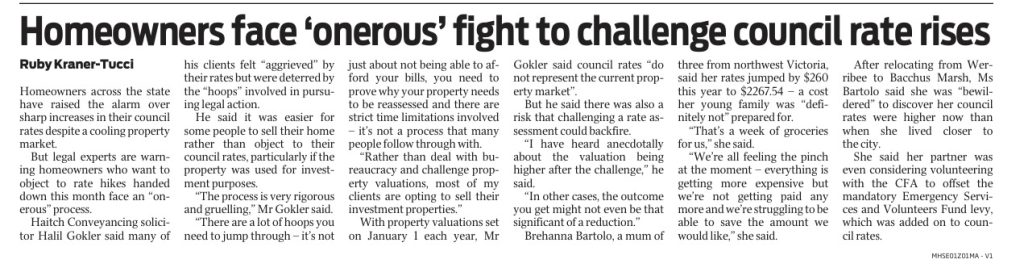
Haitch Conveyancing solicitor Halil Gokler spoke to the Herald Sun about Victorian council rate increases and the property valuation objection process.
What If Your Property Valuation Objection Is Rejected?
If you’re dissatisfied with the outcome of a valuation objection, further review rights may be available.
In relevant circumstances, valuation disputes can ultimately be referred to the Victorian Civil and Administrative Tribunal (VCAT).
There are additional procedural requirements and deadlines involved in seeking a review, so property owners considering further action should carefully review their decision notice and the applicable requirements.
Is It Worth Challenging Your Property Valuation?
A significant increase in your council rates does not automatically mean there is a valid basis for lodging an objection.
Before objecting, consider questions such as:
- Has your property’s assessed value changed significantly?
- Does the property information on the notice appear accurate?
- Which valuation are you disputing?
- Why do you believe that valuation is incorrect?
- What value do you believe should apply?
- What information do you have to support that position?
- Are you still within the objection deadline?
Halil Gokler told the Herald Sun that some property owners find the process rigorous because it involves more than simply demonstrating that they cannot afford their rates. Property owners need to establish why the property should be reassessed and comply with strict time limitations.
Understanding those requirements before lodging an objection can help you determine your next step.
What If Higher Council Rates Are Affecting Your Investment Property?
Council rates are one of several ongoing costs property investors need to consider when deciding whether to continue holding an investment property.
In the Herald Sun, Halil Gokler said some of his clients had chosen to sell their investment properties rather than go through the process of challenging their property valuations.
Selling an investment property is a much broader financial decision and should not be based on council rates alone.
However, if you have already decided to sell, it is important to understand the conveyancing process, contract requirements and other legal steps involved before your property goes on the market.
Selling a Property in Victoria?
If increasing property costs have contributed to your decision to sell your home or investment property, Haitch Conveyancing can help with the legal side of your property transaction.
Our team can assist with preparing your contract and Section 32 Vendor Statement and guide you through the conveyancing process from preparing your property for sale through to settlement.
Get in touch with Haitch Conveyancing Melbourne to discuss your property sale.
Council Rates Victoria FAQs
Why did my council rates go up so much?
Your council rates can increase because of changes in your property’s valuation, movements in property values across your municipality, council rating decisions and other charges appearing on your notice.
If your total bill has increased significantly, compare each component with your previous year’s notice rather than looking only at the final amount.
Can I challenge my council rates in Victoria?
You can formally object if you disagree with the property valuation shown on your council rates notice.
Simply believing your council rates are too expensive is not, by itself, grounds for a valuation objection.
How long do I have to object to my property valuation?
In most circumstances, you have two months from the notice being given to lodge your valuation objection.
Where do I lodge a council valuation objection?
If you’re objecting to a valuation shown on your council rates notice, lodge your objection with the council that issued the notice
Can I object to my Capital Improved Value?
Yes. If you believe the Capital Improved Value or another relevant valuation shown on your rates notice is incorrect, you may be able to lodge a valuation objection.
Does the rate cap mean my council rates can only increase by that percentage?
No.
The rate cap applies at the council level rather than setting a maximum percentage increase for every individual property.
Your individual rates may increase by more or less than the rate cap, and certain charges appearing on your rates notice are outside the cap.
What is the Emergency Services and Volunteers Fund?
The Emergency Services and Volunteers Fund is a Victorian property levy collected through council rates notices.
It replaced the Fire Services Property Levy from 1 July 2025 and contributes towards a broader range of emergency services.
How is the Emergency Services and Volunteers Fund calculated?
The ESVF consists of a fixed charge based on property classification and a variable charge calculated using the property’s Capital Improved Value and classification.
Can I object to the Emergency Services and Volunteers Fund?
An objection relating to the ESVF can concern the property’s valuation or AVPCC classification. The State Revenue Office directs property owners to their local council for information about lodging an objection.