When a property settlement goes wrong, the first formal legal step is almost always the same: serving a default notice in a property contract in Victoria. This document sets the enforcement process in motion, puts the defaulting party formally on notice, and opens the door to remedies that can include termination of the contract, forfeiture of the deposit, and a claim for damages.
For buyers and sellers alike, a breach of contract in a property sale can arise in ways that are not always anticipated — a missed settlement date, an undischarged mortgage, a failed finance condition, or a seller who cannot provide vacant possession on time. Whatever the cause, the steps that follow are governed closely by the terms of the contract of sale and the requirements set out in Victorian property law.
This article explains what a default notice in a property contract in Victoria is, when it can be served, what happens after it is issued, and the financial consequences that can follow if the breach is not remedied in time.
What is a default notice in a property contract in Victoria?
A default notice in a property contract in Victoria is a formal written notice served by one contracting party on the other. It specifies that the recipient has breached one or more of their obligations under the contract and requires them to remedy that breach within a defined period.
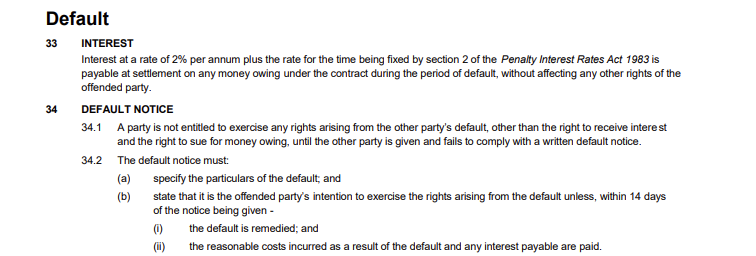
In Victoria, most residential property transactions are governed by the Law Institute of Victoria (LIV) contract of sale. The right to issue a default notice, and the procedural requirements for doing so, are set out in General Condition 34 of that contract. Under General Condition 34, a written default notice must be served before the offended party is entitled to exercise most contractual rights arising from the other side’s breach. The notice must clearly state the particulars of the default and give the defaulting party 14 days to remedy it.
One important point: a default notice does not need to state what consequences will follow if the breach goes unremedied. Its role at this stage is simply to put the defaulting party formally on notice and give them a fair opportunity to fix the problem before more serious steps are taken. Courts will only enforce a default notice where the wording is clear, precise, and unambiguous — imprecise or vague descriptions of the breach are among the most common reasons default notices are challenged and set aside.

Buyer default
A buyer is in default when they fail to meet a key obligation under the contract. The most common example is failing to pay the balance of the purchase price on the scheduled settlement date. This type of breach of contract in a property sale immediately entitles the vendor to issue a default notice under General Condition 34 of the LIV contract.
Other circumstances that can give rise to a default notice in a property contract in Victoria on the buyer’s side include:
- Failing to comply with a special condition of the contract, such as a requirement to provide evidence of finance approval by a nominated date
- Failing to pay the deposit within the period specified in the contract
- Repudiating the contract by communicating a clear intention not to proceed with the purchase
Where a buyer is in default, the vendor may serve a default notice under General Condition 34, formally commencing the remedy period. If the default is not remedied within 14 days, the vendor may then take further action, including rescinding the contract and pursuing the buyer for losses.
Seller default
Buyers often assume that default notices are only served on purchasers, but sellers are equally capable of default. A buyer has the same right to issue a default notice in a property contract in Victoria when the seller fails to perform their contractual obligations. In these circumstances, the notice served on the seller is commonly referred to as a vendor default notice
Common situations that can give rise to a vendor default notice include:
Failing to provide clear title to the property at settlement — for example, where a mortgage, caveat, or other encumbrance has not been discharged in time
- Failing to give vacant possession of the property on the settlement date where the contract requires it
- Being unable or unwilling to complete settlement on the agreed date due to issues within the seller’s control
Where a seller is in default and a vendor default notice is served, the buyer may — if the breach is not remedied within the notice period — be entitled to rescind the contract, recover their deposit in full, and claim damages for losses caused by the seller’s failure to perform.

When can a default notice be issued?
A default notice in a property contract in Victoria can be served as soon as a party is in breach of a contractual obligation. However, the offended party must be satisfied that a genuine breach has actually occurred before serving the notice. Issuing a notice based on a misidentified or inaccurate breach — or where no breach has in fact taken place — can expose the serving party to a claim that they have themselves repudiated the contract, reversing the legal positions of the parties entirely.
Missed settlement
The most common trigger for a notice of default at settlement in Victoria is a missed settlement date. Settlement must take place on the date specified in the contract. If either party is not ready — because the buyer’s funds are not in order, the seller’s mortgage has not been discharged, or required documents have not been provided — that party is immediately in default and a default notice may be served.
Under General Condition 33 of the LIV contract, penalty interest begins accruing on the balance of the purchase price from the date of default. This accrues daily, meaning even a short delay carries a real financial cost. The offended party should seek legal advice promptly and consider serving formal notice without delay — allowing time to pass without taking formal steps can complicate the enforcement of rights later in the process.
Failure to comply with the contract
A default notice in a property contract in Victoria is not limited to situations involving a missed settlement date. It can also be triggered by any other breach of contract in a property sale. If the contract includes a special condition requiring the buyer to provide evidence of finance approval by a specified date, failure to do so is a breach entitling the vendor to serve a default notice. If the seller is required to carry out agreed repairs, provide particular documents, or discharge an obligation before settlement, failure to do so entitles the buyer to serve one.
In each of these cases, the notice of default must identify with precision the specific contractual obligation that has not been met. Vague or generalised descriptions of the breach are among the most common reasons default notices fail to withstand legal challenge. The more clearly and accurately the breach is described, the stronger the position of the party serving the notice.
What happens after a default notice?
Serving a default notice in a property contract in Victoria is the beginning of a formal process, not the end of it. Once the notice is served, the defaulting party has an opportunity to remedy the breach. What happens next depends on whether they do so within the time allowed, and what the offended party then chooses to do.
Time to remedy
Under the standard LIV contract, the defaulting party has 14 days from the date the default notice is served to remedy the breach. During this period, the offended party cannot terminate the contract on the basis of the default — they must allow the notice period to run its course before taking further action
What constitutes remedying the default depends on what the breach was. A buyer who missed settlement must be ready and able to complete and must pay any penalty interest that has accrued. A seller who failed to discharge a mortgage must arrange the discharge and be in a position to pass clear title at a rescheduled settlement. A party who failed to provide required documents must supply them within the notice period.
In practice, many disputes are resolved during the 14-day notice period through negotiation. Agreeing on a new settlement date, negotiating a waiver or reduction of penalty interest, or resolving a title defect are all common outcomes. Neither party is legally required to negotiate, but most prefer a negotiated resolution to the cost and uncertainty of formal termination proceedings where the deal is still viable.
Termination rights
If the default is not remedied within the 14-day notice period, the offended party becomes entitled to take further action under General Condition 35 of the LIV contract. At this point, they may serve a rescission notice, which goes further than the original default notice.
A rescission notice states that unless the default is remedied, and any outstanding penalty interest and reasonable costs are paid within the time specified in the notice, the contract is at an end.
Whether the original notice was a vendor default notice served by the buyer or a default notice served by the vendor, the same precision requirements apply to a rescission notice — courts will only give effect to a rescission notice where the wording is unambiguous and the steps leading to it were correctly followed. The most common errors are inaccurate descriptions of the breach and incorrectly specified timeframes
Financial consequences of default
The financial consequences that can follow from a default notice in a property contract in Victoria are significant and begin accruing immediately. Whether the defaulting party is a buyer or a seller, the exposure can extend well beyond the immediate transaction to include ongoing interest charges, legal costs, and claims for losses that were caused by the failure to perform.
Penalty interest
Under General Condition 33 of the LIV contract, penalty interest accrues on the outstanding balance of the purchase price from the date of default. The standard rate is 2% per annum above the rate set under the Penalty Interest Rates Act 1983 — currently 12% per annum under an unamended contract, though many contracts include special conditions that set a higher rate.
Interest is calculated daily. On an $850,000 purchase, that equates to approximately $280 per day — meaning a 14-day notice period alone can cost the defaulting party close to $4,000 in interest before any other consequences are taken into account.

Deposit forfeiture
If a buyer defaults and the vendor proceeds to terminate the contract following the default notice and a subsequent rescission notice, the buyer’s deposit is forfeited. The vendor is entitled to retain the full deposit as compensation for the buyer’s breach. On a typical Melbourne property transaction, this can amount to tens of thousands of dollars — a significant loss even before any further claims are considered.
Resale losses and damages
Following a buyer’s breach of contract in a property sale, if the vendor terminates and is forced to resell the property, they can pursue the defaulting buyer for the shortfall between the original contract price and the resale price, together with legal costs and any additional interest charges.
This exposure is particularly serious where market conditions have softened between the original contract date and the resale, leaving the vendor to absorb a significant price difference on top of their other losses.
Buyer’s losses on vendor default
Where a buyer issues a vendor default notice and the seller fails to remedy the breach, the buyer may rescind the contract and recover their deposit in full. Beyond the deposit, the buyer may also have a damages claim for losses flowing directly from the failed settlement — including bridging finance costs, rental expenses incurred while waiting to move, storage fees, and wasted removalist costs.
The notice of default at settlement in Victoria formally triggers the clock on these rights, which makes timely and accurate service of the notice critically important.
Stamp duty on penalty interest
There is one further financial consequence that is frequently overlooked. Under Victorian State Revenue Office guidance, penalty interest paid by a buyer to a vendor as a result of a delayed settlement forms part of the dutiable value of the property. This means a default that results in a delayed settlement can increase the stamp duty payable on the purchase — compounding the financial impact beyond the interest charges themselves..
Looking to buy or sell in Melbourne?
If you need assistance with your property purchase or sale, the experts at Haitch Convey are here to support all eligible home buyers through the process. Contact us today to get started on your path to owning property.